Wednesday, August 12, 2026

"Your Deepest Responsibility" Spider-Man Brand New Day Review

Spider-Man Brand New Day
3.5/5
Directed by: Destin Daniel Cretton
Rated: PG-13

           The Marvel Cinematic Universe (MCU) is in theaters once again. That means it's time to pull out those recap videos and brush up on that lore. Otherwise, one might not be able to point out every single cameo and say, "I know who that is." Alternatively, one could simply watch these movies and try not to worry about all the jargon they will inevitably miss. Either option has proven to be a detriment to most recently released MCU movies and shows—but not this film. If you paid attention during No Way Home (2021), you're more than ready to experience a Brand New Day.
           Tom Holland is back, in a role that he can (and does) play in his sleep. His sincerity as both Peter Parker and Spider-Man is always welcome, but what's new is his rugged maturity. He's no longer a wide-eyed teenager, but a man struggling with deep regrets. It is admirable watching Holland's quiet resolve as he makes one tough choice after another.
           Peter's not completely alone. To his frustration, he is joined by the loud mouthed Frank Castle, a vigilante known as the Punisher. Jon Bernthal (who's played the role on TV for ten years) gives this brash soldier a genuine charm, without sanding off his edges. There is also the meek and reserved MJ, played by Zendaya. She helps flesh out a large supporting cast. Standouts include Jacob Batalon, Sadie Sink and Tramell Tillman. The screen is bursting with faces, possibly too many. It might have helped streamline the story, if it held-back on the size of its cast. Certainly, all of Florence Pugh's scenes could've been cut. She is, as her character says, "small potatoes."
           Despite the large cast, this film happens on a more intimate scale. This MCU flick is not about teams of heroes stopping an intergalactic threat. It's a heartfelt drama about a young man facing the turmoil within him. That man, however, is Spider-Man, so his struggles include stopping an armored tank, managing his evolving arachnid powers, and working out how to have a social life when he spends his days under a mask. These challenges will intrigue adolescent viewers but they might be too cerebral for children. Brand New Day isn't quite a family film, but it's one that families can enjoy.
           What's truly enjoyable are the action scenes. Never before has the camera brought audiences so close to Spider-Man's chaotic world (right under his mask, up to his eyeball). When Spider-Man spins, New York spins around him. When he falls, skyscrapers soar past him. When he pulls on a web, audiences feel the tension. The special effects are seamless. It's hard to tell when it's a computer graphic and when it's just excellent stuntwork. Eventually, audiences learn to sit back and trust what they're seeing. When that happens, they're in for a thrilling ride.
           Brand New Day is definitely a cinematic experience, however it's difficult to say if it's a theatrical one. That's because this film doesn't feel so much like a movie but more like the entire season of a streaming show. The narrative is a tangled web of relations, secrets and character arcs, yet it doesn't make viewers strain to follow it. All these elements build to a memorable climax, but it can be confusing as to when the movie has reached that climax. In a TV show, this much build-up is vital. In a movie, it's typically better to keep these things sharper. Still, for how beefed-up this story is, it manages to pack a wallop and bring home a satisfying ending.

Verdict: Spider-Man Brand New Day is a dynamic character drama, which takes a long time to build to its thrilling climax, but it is fun watching the continuing development of everyone's favorite web-head.

Wednesday, January 31, 2024

"あれがゴジラ" Godzilla-1.0/C Review

Godzilla-1.0/C
5/5
Written, Directed and Visual Effects by: Takashi Yamazaki
Rated: PG-13

           April, 1945: Japan has lost everything after the second world war. The country has fallen from "zero" to "minus." The nation's population is broken and desperate. Then, the radios bring a report. A massive under-sea creature was sighted off the coast, leaving a wake of destruction. It is heading for our homes and loved ones, and will crush all we have left. It is the gripping fear of war; the devastating results of the atomic bomb; the anxiety of what awaits tomorrow. Will anything survive the avenging malice of Godzilla?
           Godzilla Minus One (2023) is the latest film from the Toho Entertainment Company. This project was led by Japan's foremost director and visual effects artist, Takashi Yamazaki. It has been in development for roughly five years and, upon its release, received universal praise (garnering a 100% on Rotten Tomatoes in its opening weekend). This reviewer, though, was not able to see that film.
           Godzilla-1.0/C, pronounced "Godzilla Minus One Minus Color," is the black-and-white version of Godzilla Minus One. It is playing for a limited release in cinemas from January 26 through February 1. Director Takashi Yamazaki says this version was made by colorists who "took the care and the time to go through a careful and very complex process." Yamazaki states, "The black-and-white images make Godzilla look very realistic and documentary-like, which leads to even more fear," going as far to say one of the scenes in this version "was so terrifying it made his knees shake!" Yamazki also says, "This is not only for those who liked Godzilla Minus One but also those who are seeing it for the first time. They should definitely see this black-and-white version." This reviewer saw that film.
           With Minus One, director Takashi Yamazaki brings audiences into the homes and lives of postwar Japan, with remarkable authenticity. His eye-witness view of families in bombed wreckage has a sense of compassion. He illustrates employment opportunities in this culture as hope for the future as well as sunshine for today. He shows an admirable understanding of an ex-soldier's trauma along with the honor of their service. His story's events are detailed with the exact battleships and airplanes from this era, even featuring their names and their historical outcomes from World War II. With all of this and more, Yamazaki turns the modern movie screen into a portal to the past.
           But Minus One is not just a biographical period-drama. It's a Japanese monster movie, and this means terror, screaming and lots of destruction. Even here, Yamazaki delivers as the film's visual effects supervisor, pulling movie-goers dangerously close before the mighty Godzilla. His footsteps pulverize city streets and shake movie theater seats. His tail obliterates buildings, as audiences brace for impact. His jaws hurl screeching metal skyward and send screaming crowds backwards. And his roar erupts with resounding force as people gaze in stunned silence.
           These terrifying visual effects could clash with the film's humane direction, but they are held together and strengthen each other through, once again, Yamazaki as the film's writer. His story centers around a failed kamikaze pilot, too afraid to die and too petrified to live. Through this main character, Yamazaki unfolds a gripping and entertaining story with a profound and life-affirming message. Minus One's screenplay is rich with action, comedy, commentary, heart, despair and resolve. Surprisingly, none of these aspects upstage one another. Instead, every moment of passion wells up with emotion and every attack from evil raises dread. With so many excellent scenes, viewers may catch themselves thinking, "Go back. I want to see that again!" Those who avoid historical dramas may find themselves invested in the characters' situations. Likewise, the adults who scoff at silly creature features might be unable to look away from the king of the monsters.
           Minus One could also boast of its extraordinary cast, but they consider themselves far too humbled. Lead actor Ryunosuke Kamiki states he is "lucky to be part of the Godzilla universe," and would be happy if the "fans would take him under their wing." Kamiki's co-star Minami Hamabe also describes having the chance to be in a Godzilla film as "a joy and an honor" as well as "a childhood dream come true." Their privilege is the movie-goer's pleasure, with everyone in this distinct cast giving an incredible performance. To bring attention to a few: Munetaka Aoki as the grizzled Tachibana, Hidetaka Yoshioka playing the eccentric "Doc" Noda, Sakura Ando portraying the prickly Sumiko, and an endearing child actress playing little Akiko. All these actors let their performance fill their face, voice and body, allowing audiences to empathize with any of Minus One's characters.
           The release of Minus One marks 70 years in the monster's franchise, and Minus One celebrates this in spectacular fashion. The film takes inspiration and gives homage to the more than dozens of Godzilla films before it. Director Yamazaki cited Godzilla, Mothra and King Ghidorah: Giant Monsters All-Out Attack (2001) as his personal favorite Godzilla film, and the Godzilla in that film helped inspire the visual look and scale of Minus One Godzilla's atomic breath. Musical composer Naoki Satō uses theme arrangements from earlier films in Minus One's poignant score. Several scenes in Minus One are directly inspired from previous Godzilla films, and Minus One's primary story comes from Ishirô Honda's original 1954 film. Yamazaki believed he "should stay true to the original film's spirit, addressing the issues of war and nuclear weapons."
           While Minus One shares multiple traits with its predecessors, Yamazaki's work is unique to this beloved franchise. This is because Minus One is the first Godzilla period-piece, as the previous movies took place in the present or not-so-distant future. Specific to North America, Minus One is the first Godzilla movie to be nominated for an Oscar (for Best Visual Effects, though it should have also received Best International Feature). It is also the current highest-grossing Japanese film in U.S. box office history, having earned over 50 million dollars off of its estimated 15 million dollar budget. Having achieved this, Minus One proves it is a noble tribute to the past and a sure pathway to a bright future.
           One final note: This review would not be complete, without a word of explanation. There has not been a proper review on this blog in over 1,700 days. Why is Minus One the film to break-up this hiatus? Well, sometime in the summer of 2019 movies seemed to have hard defined audiences. There did not appear to be merit in informing people whether they should see what was going to be an obvious "hit" or "miss" with its intended demographic. In time the common narrative became, "If it was made for you, you will like it. If you don't like it, then it wasn't for you," with the implied message being, "Stay away from what's not yours." This is why Minus One has awoken this blog from its slumber: It is a film for all audiences. Fans, newcomers, young, old, male, female, national and international movie-goers can all wholly enjoy this theatrical experience.


Verdict: Godzilla-1.0/C is just as powerful, engaging and well designed as the iconic black-and-white monster from which audiences run away and can't wait to see again.

Tuesday, August 1, 2023

"That is Written" Mission: Impossible and Biblical Symbolism

SPOILERS

In the beginning back in 1996 Paramount Pictures and Tom Cruise produced a spy-thriller known as Mission: Impossible. The film received positive reviews, however most critics regarded its story as incomprehensible. This may be because the film gained inspiration from a relatively unknown source. That source being none other than the book of Job from the Bible. Don't believe me? Consider this: Mission: Impossible is the story of a man who loses his friends and family in one fateful event (Job 1:13-19). As he works to understand his calamity, he allies himself with a small team of friends, though most of them make his situation worse (Job 4-37). The climax of his story takes place in a speeding whirlwind, where the nature of his suffering becomes clear (Job 38). In the end, our main man is given back his family and his life is restored (Job 42:10-17). On top of this, the book of Job is quoted several times in the film; with overt references to chapter 3 verse 14.

The Mission: Impossible series began with inspiration from the good book, and its latest film may be continuing this tradition. It appears to incorporate characters and plot details from Revelation. This book in the Bible is about the end of the world. In the past the Mission: Impossible films have dealt with preventing global catastrophe. This Mission, though, takes place after a doomsday device is loose across the earth, much the same way it is in Revelation. Although Producer Tom Cruise and writer and director Christopher McQuarrie have not yet stated what shaped their latest film, it would be fitting if they were inspired by the Bible's apocalypse. Having now seen this excellent film twice, here are my observations on Mission: Impossible Dead Reckoning Part One and its Biblical symbolism.


The Entity and the Deceiver:
 There's a well known quote that goes, "A story is only as good as its villain," and the villain of this Mission is an A.I. referred to as the Entity. This program is described as being godless with its chief weapon being deception. In the Bible there is also a "godless" villain who is known as the deceiver (2 John 1:7). This villain is the devil. He is "the father of lies'' (John 8:44), and just like the Entity, he uses his lies to control rulers and nations (Ezekiel 28:1-19). The devil, much like the Entity, rebelled against his creator and in that rebellion brought about destruction on the earth (Isaiah 14:12-15). Now, the devil roams "throughout the earth, going back and forth on it" (Job 1:7), because the devil cannot be everywhere at once. Similarly, the Entity (even though it is a non-physical program) is described as going from one nation's network to another, being "everywhere and nowhere."


Angels and Antichrists: To keep people from suspecting them, the devil and the Entity hide their villainy behind disguises. The devil "masquerades as an angel of light" (2 Corinthians 11:14), and the Entity uses a white suited human proxy. This proxy calls himself Gabriel, which is the name of an angel referenced in the book of Luke chapter 1. Gabriel, played by Esai Morales, is described as the Entity's "dark messiah." In similar fashion, the Devil has an antichrist (2 John 1:7). With this antichrist the devil will kill many people who oppose him (Revelation 20:4). In the Bible these killings symbolically occur in Rome, where the streets run with "the blood of prophets and of God’s holy people," (Revelation 18:24). Gabriel and the Entity also do most of their killing in Rome and Venice. The Entity and the devil are great forces of evil, however they share the same weakness; a weakness our film's hero hopes will destroy the Entity.


The Cross and the Key: The only thing that can stop a lie is the truth, and "the truth will set you free," (John 8:32). This is likely why in this Mission agent Ethan Hunt, played by Cruise, is not looking for a weapon but information. Hunt's adventure leads him to discover that the Entity's source code is in a sunken submarine located under a frozen sea. This source code can be locked away using a one-of-a-kind cruciform key. The act of using a key to lock away a great deceiver is also an important story point in the book of Revelation. In chapter 20 verse 3 the devil is thrown into an abyss, which is hell. The Entity also plummets down into a pit (one which is frozen over, mimicking Dante's depiction of hell in his book Inferno). The devil, though, as well as the Entity, is set free from this pit for a short time "to deceive the nations in the four corners of the earth," (Revelation 20:7). The one who can stop the devil is the one with the key. In the book of Revelation Jesus Christ is described as holding "the keys of death and Hades," (Revelation 1:18). Jesus is the hero of the Bible, and this Mission's hero shares some of His qualities.


The Agent and the Christ: During Hunt's mission he is tempted to use the key for himself to do what every world power wants to do, "Control the truth, and the concepts of right and wrong." In the Bible people are also tempted to decide for themselves what is good and evil (Genesis 3:1-7). Jesus Christ, though, resists this temptation (Luke 4:12-13) and so too does agent Hunt. Over the course of Hunt's adventure, he obtains the cruciform key to destroy the Entity. Similarly, Jesus is given the authority to wield the key over death, after He gives His life for His friends and those who do not yet know Him (Matthew 28:18). Agent Hunt also says his oath is to live and die "for those he holds close and for those he'll never meet." In the Bible Jesus says if anyone wants to follow Him they must "take up their cross" (Matthew 16:24), however in doing so the world will then try to kill them (John 15:18). Agent Hunt as well is described as bearing a cross, which is defined as, "The closer someone gets to him, the harder it is to keep them alive." In order to protect those who follow Him, Jesus promises He will lay down His life for anyone who comes to Him (John 10:15), and Hunt promises his teammates, "Your life will always matter more to me than my own."


Failure and Faith: Despite all his apparent similarities to Christ, Hunt is not meant to be seen as a figurative depiction of Jesus. This is because, unlike Jesus who never sinned (1 Peter 2:22), Hunt is not a perfect person. One of his greatest follies displayed in the film is his desire to take revenge into his own hands. Contrary to Hunt's desires, the God of the Bible says, "It is mine to avenge; I will repay," (Deuteronomy 32:35). Those who fail to obey God are not perfect, and they need to put their trust in God (Proverbs 3:5). This trust, or rather faith, will be tested in order to prove that it is genuine. In the Bible God tests the faith of His followers (Hebrews 11:17–19). In a similar way, Hunt is tested after he fails to get on board a speeding train. Having no other options, Hunt listens to his trustworthy friend, played by Simon Pegg, who leads him up to the top of a mountain. At the cliff's edge Hunt is told he needs to jump from the mountain's side in order to successfully land on the speeding train. Hunt is in disbelief, but eventually he trusts his friend's guidance and takes a "leap of faith" (it is even called this on the film's soundtrack). Hunt's faith is rewarded, as is the faith of those who put their trust in God (Hebrews 10:35).


Thieves and Cowards: Hunt is not the film's only flawed character, nor is he its greatest. That position is held by the woman known as Grace, played by Hayley Atwell. Grace is introduced in one short phrase, "She's a thief." The Bible says thieves are sinners in danger of burning in hell (1 Corinthians 6:9-10). In the film Grace is constantly in danger. She knows the dire situation she's in, but instead of changing her lifestyle, she resorts to running away. She's not only a thief, but a self-preserving coward, and the Bible says all cowards have a place in eternal destruction (Revelation 21:8). Grace is a woman in need of saving, much like all sinners on earth (Romans 3:23), so she tries to save herself. Grace's plan, however, doesn't work, just like how anyone who tries to save themselves outside of Christ will ultimately fail (John 14:6). Grace is in trouble. She needs help, but she doesn't deserve it. In short: Grace needs grace.


Grace and Salvation: Hunt doesn't want Grace to die. He does everything he can to save her, but Grace is continually antagonistic to him. This dynamic also appears in Scripture, where Jesus rushes to seek and save the lost (Luke 19:10), but those who need Him reject Him (John 5:43). Jesus, though, is not stopped by the actions of His enemies, and Hunt is similarly unshaken. He offers Grace the choice to either go back to her life with the expectation of her demise, or she can freely join Hunt and become a new person. This good news from agent Hunt is similar, although disparagingly different, from the Bible's gospel. Jesus says anyone who freely follows Him will be "born again" (John 3:3) as a "new creation," (2 Corinthians 5:17). Someone is saved by Jesus, when they put their trust in Him (John 1:12). A similar act of trust also saves Grace. In the film's spectacular climax, agent Hunt tells Grace that he can save her if she trusts him. At first Grace doesn't, but then she puts her faith in him, and Agent Hunt doesn't let her down. The film concludes with Grace having a new life, as Hunt races off to continue his mission to destroy the Entity and save the world.

Friday, June 19, 2020

Letters from War: Contemporary Insight from "Glory" (1989)

Cinema Romantico: Friday's Old Fashioned: Glory (1989)

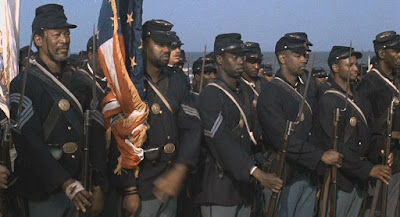
I hadn't planned to watch this 1989 best picture contender today, but I am overjoyed that I did watch Glory, especially considering where our country is in this time. The story of Glory is about the 54th Massachusets Volunteer Infantry, which was a Union troop formed of all black men. The film stars Matthew Broderick, Denzel Washington and Morgan Freeman as brave Union soldiers who would risk their lives to keep this nation united under God. All of these actors give remarkable performances, the screenplay is expertly crafted, the production design impeccably reflects the look of 1860s America, and James Horner's score is phenomenal. All of this brought me nearly to tears as I watched this film, but what moved me most about director Edward Zwick's Glory was this film's incredibly stirring commentary on the relations between black men and white men in America, and how relevant this commentary still is.

One of the ways this film shows people can stand up for equal justice is by not endorsing injustice. In one scene Colnel Robert Shaw's all black regiment is told that they will be paid less money than the amount a white regiment would make at that time. Throughout the film, Shaw's real life letters that he wrote to his mother are read in voice over, and in one of those real life letters Shaw wrote, "You may have perhaps heard that the coloured troops are to receive $10 instead $13 per mo. It is not yet decided that this regt comes under the order. If it does I shall refuse to allow them to be paid." Here Shaw as the leader of his men takes a stand against the injustice of unequal pay, by not accepting it. In this way the Colnel continues to, as he says in the film, "fight for men and women whose poetry is not yet written but which will presently be as enviable and as renowned as any."

A consistent motif in this film is the importance of treating everyone with the same level of dignity and respect, because all men have been equally created by God. In one scene Colnel Shaw worries that his drill seargent is treating his troops too harshly, however the drill seargent informs Shaw that this is how boys in the army become men. In one scene a Major (played by Cary Elwes) confronts the Colnel about his treatment of the soldiers at the camp, and he concludes that they should be treated like men. This undercurrent of tension is present throughout all of the boot camps scenes: that all enlisted men are put through tough training no matter their skin color, to make them the best soldiers this country can have.

One final scene is where a soldier played by Denzel Washington, whose character grew up as a slave, begins to harassas another black solider in the army. Throughout the film Washington's character has been belligerent and full of contempt, and in this scene Washington tells his fellow soldier "Let me tell you something, boy. You can march like the white man, you can talk like him. You can sing his songs, you can even wear his suits. But, you ain't NEVER gonna be nothing to him, than an ugly ass chimp... in a blue suit." At this point Morgan Freeman's character intervenes to gain control of the situation. Washington's character then, refers to Freeman's as "nothin' but the white man's dog!" Freeman responds, "And what are you? So full of hate you want to go out and fight everybody! Because you've been whipped and chased by hounds. Well that might not be living, but it sure as hell ain't dying. And dying's been what these white boys have been doing for going on three years now! Dying by the thousands! Dying for you!" He continues, "Gonna come a time when we all gonna hafta ante up. Ante up and kick in like men. LIKE MEN!" It's one of dozens of great moments in this remarkable film that speaks volumes about what it means to live a life of respect, seeking justice and liberty for all.

Glory is currently available free on Verizon OnDemand and on Movies Anywhere, thanks to the Sony Company. It's an incredible and powerful film that I am sure I will not forget, nor will I forget how glad I was to have found it during this time in our country's history.

Sunday, April 14, 2019

"I'm not going to Apologize about doing a job that Helps Women in Crisis" Unplanned Review

Unplanned
4.5/5
Directed by: Chuck Konzelman and Cary Solomon
Rated: R

           Abortion; it's what you think it is. It is likely that everyone has their own understanding and stances on it. Abby Johnson is one woman who like anyone else has her own thoughts and stance on abortion. She worked for eight years within one of the biggest non-profit abortion providing clinical institutions, Planned Parenthood, was honored in her work, promoted to high status and then left all of it. Why? It was a moment; a series of moments coming together. It was one thought; a lifetime of thoughts converging into a belief. The truth of her story is in theatres and what she saw will impact how you see abortion.
           Unplanned stars Ashley Bratcher as Johnson, who excellently portrays the highs and lows of Johnson's career; her victories and her defeats. What stands out most about Bratcher's performance is her eyes, which openly welcome audiences deep into her life story of conflict in her conscience and perseverance in her principles. The quality of Bratcher's performance is matched by the film's other aspects. Scenes are well directed and engaing complimenting the film's captivating screenplay. Though the screenplay features voice-over narration (which most viewers consider a tropic narrative device), Unplanned utilzes this to provide neccessary personal commentary serving to bring audiences deeper into Johnson's experiences as well as their own. Unplanned's imagery is its most thought provoking aspect, asking audiences to question what they consider abnormal/natural or unconventional/commonplace. Though the film does feature minor pacing issues, wherein similar dialogue heavy scenes can make audiences disengage from the film for up to five minutes, Unplanned features no marring or glaring faults with its technical and cinematic aspects. This is impressive, when it is considered which company produced this film.
Abby Johnson's best
selling book "Unplanned"
inspired this film's story.
           Unplanned was produced by Pure Flix, an American production company that primarily produces Christian thought based films. They arrived on the public scene when they released God's Not Dead (2014) which received flack followed by two more sequels and more flack. Pure Flix also produced a lesser known film titled Do You Believe? (2015), which was a mish mash of poorly interwoven character stories. Needless to say Pure Flix produced few worthwhile feature length stories, until in 2016 when they released a bio-graphical feature, I'm Not Ashamed (2016), telling the story of Rachel Joy Scott, the first student killed in the Columbine High-School shooting of 1999. This movie along with the superior The Case for Christ (2017), the life changing story of journalist Lee Strobel, showed Pure Flix had a knack for adapting compelling real life Christian stories. Pure Flix's growth as a production company is more evident than ever through Unplanned, a mature and provocative bio-graphical film. Having ranked number four in its opening weekend at the box office, Unplanned shows Pure Flix is capable of telling amazing and memorable real life stories.
           Pure Flix's films have always strived to offer relative Christian based commentary on present and important topics. Though Pure Flix's past films have depicted people on one side of a topic as righteous and people on the other side as wicked, Unplanned takes no hard stances on its portrayal of women who have had abortions or have worked in providing abortions. Neither does the film show abortion procedures as being safe or dangerous. Unplanned depicts abortion procedures with a sense of genuine earnestness that does not seek to scare or assure. The film simply desires to relay the truth of Abby Johnson's story. In spite of this film's R rating, this film about the shocking topic of abortion does not play up its possible "shock factor." There are no sudden violent images; no cheap disturbing dream sequences. There is no gore, no anatomy and no profanity. Everything that is visceral and bloody (which there is visceral and bloody imagery) is shown with care, depicted with an authenticity that appears grounded in reality. Unplanned does not want to frighten its audiences. Unplanned wants to shake its audiences and make them think about their stance on abortion and how they will respond to this important topic.

Verdict: Unplanned tells the truth of Abby Johnson's story at Planned Parenthood, with an engaging lead performance and realistic graphic imagery, making it Pure Flix's most mature and compelling film.

Wednesday, February 27, 2019

"We need to Fail down here, so we don't Fail up There." First Man Review

First Man
4/5
Directed by: Damien Chazelle
Rated: PG-13

           In 2014 director Damien Chazelle made himself a name at the Oscars as the startup writer and director of the psychological thriller about a musician's pursuit of greatness known as Whiplash. Two years later, Chazelle again recieved high remarks around his name for writing and directing the original Hollywood musical smash hit La La Land. Chazelle's recent film moves away from his typical form, by using his directorial prowess to take audiences beyond the stratosphere. With Chazelle's First Man he tells the story of Neil Armstrong, the first man on the moon, presented as a compelling psychological thriller.
           First Man stars Ryan Gosling as Neil Armstrong who plays the famous astronaught in a manner that is surprisingly introverted. As Armstrong was not the hotshot pilot most NASA astronaughts were, Gosling's depiction is startingly accurate if not also a little bit offputting. Gosling's counterpart is Claire Foy who portrays Armstong's headstrong wife Janet Armstorng with an indominatble spirit. While Gosling's character is taken to astonishing heights, Claire Foy's remians grounded. Gosling and Foy's characters share a tangible bond stronger than anything they face. This bond is shown strongest when Gosling and Foy are not being husband and wife but Father and Mother. The parental warmth and love these two extend to their two children, played exceptionally well by child actors Luke Winters and Connor Blodgett, is endearing. These scenes of the Armstrong's domestic life show how insane it is that this man, Neil "the neighbor with the pool your kids come over and play in" Armstrong, is going to be the first man on the moon.
           The dangers of putting an ordinary man into space have never appeared as intense and realistic as they do in Chazelle's First Man. These gripping scenes are shot by cinematogprapher Linus Sandgren, whose first person perspective visuals place audiences directly in the claustrophobic and accurately reproduced cockpits of the some of the fastest space crafts to breach Earth's atmosphere. Inside these cockpits anything can go wrong resulting in catastrophic consequences. An electical wire can ignite. A bolt can come undone. The cockpit can start rolling. Anything up there can fail, and when it does only an astronaught's training and their determination is the only thing that can save them. Building upon the dramatic tension in these scenes is Justin Hurwitz's subtle score comprised of unique instruments, such as the otherworldly thermin. This score of slowly intensifying anthems reflecting the characters' mindsets adds vitality and weight to First Man's engrossing atmosphere. This combined with the film's Oscar winning special effects make First Man's space flight scenes thrilling and strenuous for both those in and outside of the film.
An iconic image of Neil Armstrong on the moon.
Source: lights in the dark
           Beyond this film's compellling performances and intense scenes, First Man is remarkably accurate to real life events. The Smithsonian National Air and Space Museum describe First Man as "the most accurate fictional depiction of human spaceflight in the 1960s ever made," stating that "the care of the director, Damien Chazelle, and his team to respect the integrity of historical events is obvious to anyone with a solid knowledge of the Gemini and Apollo programs." The film's visuals also add historical accuracy to the film, as some of First Man's shots were created directly from historic archive footage. This footage is blended seemlessly with the film's cinematography. This film also features a wide range of interesting fun facts about Armstrong's personal life interspersed across the film. One of which is that Armstrong wrote showtunes for his alma mater, Purdue Univeristy. The film also accurately depicts the public's opinion of NASA and the various protests against NASA, including the reading of a spoken word poem that was written at that time. All of these historical elements are what make Josh Singer's screenplay historically vibrant. In combination with the rest of the phenomenal work put forth by this film's cast and crew, Damien Chazelle's First Man is a great psychologically thrilling piece of cinema. It is a worthy addition to Chazelle's repitoire and it can make audiences wonder where this filmmaker will take them next.

Verdict: Damien Chazelle's First Man is a compellingly performed and directed psychological thriller about Neil Armstrong, the first husband, father and neighbor to ever successfully step on the moon.

Tuesday, January 22, 2019

"They Always Underestimate the Mastermind." Glass Review


Glass
4/5
Written and Directed by: M. Night Shyamalan
Rated: Pg-13

           David Dunn was an unsuspecting security guard, until he discovered he was unbreakable. Kevin Wendell Crumb's mind features 23 personalities and one beast that made them split. Elijah Price was a broken man without a purpose, until he saw his life through a clearer looking glass. A hero, a monster and a mastermind: these are the urban legends of Philadelphia that appear to be lifted straight from a comic book. Despite their uncanny natures, they live in a real world bound by the rules all humans must live by. Of course, how can they be comic book characters and be real people? They can't be, can they? Are these super-humans among us?
           Glass is writer and director M. Night Shyamalan's conclusion to his unexpected comic book trilogy. Since 2016 when Shyamalan announced he was making this film, fans have been anxiously awaiting this story's debut. In Glass nearly all of Shyamalan's personas from Unbreakable and Split return. Bruce Willis is David Dunn and he makes the most of his heroic character, despite his limited screentime. James McAvoy is the Horde, a human comprised of 23 identities including the calculating Patricia, the unsteady Barry, the nine year old Hedwig and the indomitable Beast. McAvoy holds most of the camera's attention and he plays it up, seamlessly moving from one personality to the next while differentiating them. Topping them all is Samuel L. Jackson once again donning his purple attire and wheelchair as Mr. Glass. Jackson remains on the sidelines, but captivates audiences through his facial ticks and mesmerizing eyes. Jackson might play his character as a washed up nobody, but it is clear Mr. Glass is the center of this story.
           More intriguing than these characters is how these characters are brought together. Shyamalan builds this introspective story one event at a time with each conversation adding a new layer to the film. As these layers increase, the film's characters converge. These characters also represent different archetypes from comic book lore, and it is entertaining seeing who from Shyamalan's films has become a sidekick, a henchman or a love interest. The screenplay plays with comic book lingo and tropes in a way that fans can appreciate. Newcomers may not fully understand Glass' narrative, because most of this film's story elements and plot points are only established in Shyamalan's previous films. Glass can be entertaining, but it's story will sound like jargon to any audience member who does not competently understand these characters' backstories.
           Audiences who were invested in Glass' predecessors will likely find enjoyment in this film. Glass not only references these previous films through its screenplay but also through the film's direction. Certain scenes are accented by musical themes from the previous films. Shyamalan also uses shots and camera angles from the previous films, as visual cues to hearken back to the previous films. Glass blends these familiar shots together with its own storytelling perspective. This film's first half is shot in a generic style mimicking most MARVEL films, while its second half breaks through these visual conventions. This allows Glass' cinematography to illustrate the story through its visual style and tone, which heightens this film's climax.
           Shyamalan's films are most infamous for their surprise endings. Glass features a surprise ending. It is excellently telegraphed through visual cues scattered throughout the film and dialogue interactions that at their time in the film seem unimpressive. Once this film's big twist ending occurs, audiences will likely recall this film's earlier moments and how they were subtly propelling the story to its conclusion. This does not mean audiences will want to watch Glass again, as its ending is incredibly polarizing. Some may think it is a cop-out, while others may congratulate it. Either way, this film's ending is memorable and will leave audiences in awe of Shyamalan's latest film.

Verdict: Uniting Unbreakable and Split, Glass offers an entertaining and introspective experience brought to life by great characters, an engaging screenplay and thought provoking direction.